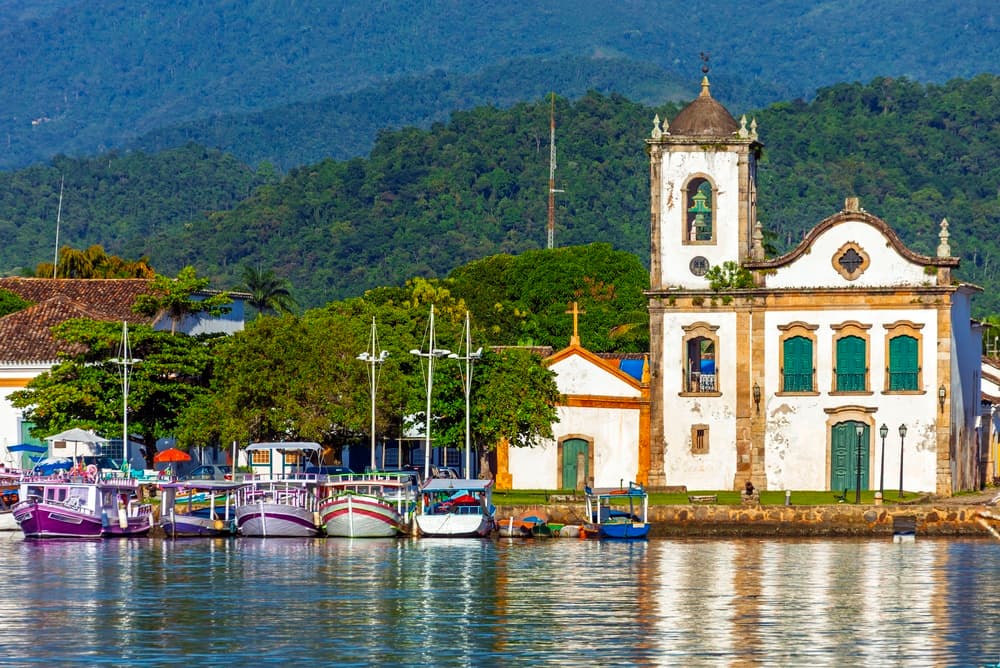
Rio de Janeiro
Ocean and mountain living in a Portuguese-speaking big city: Zona Sul beach neighborhoods, accredited private hospitals, and street crime you plan your habits around.
- 6,211,223
- Population (2022)
- $1,600/mo
- Monthly budget · single
- 74°F / 24°C
- Avg temperature
Budget about $1,600 a month for one person in Rio de Janeiro, with most single budgets falling between $1,400 and $1,900 in 2026 U.S. dollars. A couple spends around $2,400. A one-bedroom in the center rents for about $750, or closer to $500 farther out, in a city of about 6.2 million wrapped around beaches, a lagoon and forested mountains.
Most Americans settle in the Zona Sul: Copacabana, Ipanema, Leblon, Botafogo and Flamengo, where the beach, the metro and the big private hospitals sit close together. Rio suits people who want an outdoor, social life by the ocean and are ready to live in Portuguese. Remote workers and retirees with income from home do best, since the money goes further when it isn't earned locally.
Here's the catch: street crime shapes daily habits. Our safety index puts Rio at 36 out of 100, and the U.S. State Department singles out Rio for assaults involving drugged drinks. People who do well here carry little, keep the phone out of sight on the street, and choose their neighborhood with care.

Reviewed and updated October 9, 2026 · 4 min read
At a glance
$1,600
Monthly budget · single person
$750/mo 1-bed rent, center
36/100
Safety index
$15
Internet / month
74°Fannual average
Jul 69° · Feb 80°
Climate
6,211,223
Population (2022)
Expatsi estimates, updated Oct 2026, based on rental listings, government statistics, and local reporting.
Cost of living
What it costs to live in Rio de Janeiro
Single person
$1,400–$1,900/mo
about 50% below Austin, TX
Couple
$2,000–$2,800/mo
about 50% below Austin, TX
Family of four
$2,900–$4,200/mo
about 55% below Austin, TX
Compared with Austin, TX (Expatsi estimate, 2026).
- $7 −65%
- Inexpensive meal
- $600–$900/mo −62%
- 1-bed rent, center
- $400–$600/mo −63%
- 1-bed rent, outside
- $15/mo −77%
- Internet
- $45/mo +9%
- Transit pass
- $260/sq ft −60%
- Buy price, center
Expatsi estimates, updated Oct 2026, based on rental listings, government statistics, and local reporting.
Daily life
How Rio de Janeiro lives
- B grade, 43rd percentile among the cities we track
- Dining & caféstypical
- A- grade, 73rd percentile among the cities we track
- Arts & culturestrong
- B+ grade, 58th percentile among the cities we track
- Parks & outdoorsstrong
- A- grade, 73rd percentile among the cities we track
- Schools & educationstrong
- B+ grade, 65th percentile among the cities we track
- Healthcare accessstrong
- B grade, 48th percentile among the cities we track
- Bike infrastructuretypical
- B+ grade, 55th percentile among the cities we track
- Public transitstrong
- A grade, good physical accessibility
- Accessibilitygood
Graded on OpenStreetMap amenity density relative to the 298 cities we track. Accessibility is the exception: it's graded against a fixed standard (terrain steepness and sidewalk surfaces), not a curve.
Climate
Weather through the year
Annual average 74°F (24°C) · 48 in of rain a year · Source: Open-Meteo Historical Weather API (temps: ERA5-Land 0.1°; precip/sunshine: ERA5 best-match; 1991-2020 normals); precipitation: Meteostat station 83743 normals 1981-2010
On the ground
Scenes from Rio de Janeiro
Getting around
Transport in Rio de Janeiro
In the Zona Sul, most errands are a walk or a short metro ride away. Line 1 links the Zona Norte with downtown and the Zona Sul, and its Cardeal Arcoverde and Siqueira Campos stations serve Copacabana. Line 4 carries on through Ipanema, Leblon and São Conrado out to Barra da Tijuca. A ride costs R$7.90 (about $1.50), a fare the state froze for 2026.
Downtown, the VLT light rail links Centro, the port zone and Santos Dumont airport. City buses, the VLT and the BRT express buses share one R$5.00 fare (about $1). The BRT mostly serves the North and West zones, and it can buckle under pressure: a July 2026 bus strike left long lines at its Barra terminal. The State Department urges extra care at transit hubs and on public transport, especially at night.
Uber and 99 have operated under city rules since 2018. On Sundays and holidays a leisure bike lane links Leblon, Ipanema and Copacabana from 8 a.m. to 4 p.m., and the Lagoa Rodrigo de Freitas has an 8 km (about 5 mile) path for walking and cycling.
You can skip the car in the Zona Sul. Barra da Tijuca is more spread out, so people living there tend to drive.
For trips home, GOL started nonstop flights from Galeão to New York's JFK in July 2026, three times a week.
- 30/sq mi
- Transit stops
- 5.9/sq mi
- Bike infrastructure
- 21/sq mi
- Wheelchair-accessible places
Mapped features per square mile from OpenStreetMap.
Keep exploring
Places like Rio de Janeiro



Community & practical notes
Life between the beach and the hills
Finding your people: The Zona Sul is where most newcomers start. We couldn't confirm an active English-language expat club, so plan on building a circle through Portuguese classes, work and your building. Lessons before you arrive pay off fast.
Healthcare: Hospital Copa Star in Copacabana is accredited by Joint Commission International, and Hospital Copa D'Or has held the same accreditation for nearly two decades. Brazil's public system, the SUS, is open to foreign legal residents, while private coverage gets you into hospitals like these faster. Our Brazil healthcare report explains how the two fit together.
Working remotely: Home internet runs about $15 a month in our data. Regus and WeWork have both run coworking spaces in Rio; check current addresses before you commit.
International schools: The Escola Americana do Rio de Janeiro (EARJ) has campuses in Gávea and Barra da Tijuca, has offered the IB Diploma since 1982, and awards an American high school diploma. The British School teaches in English apart from language classes, with a campus in Urca. Our Lady of Mercy School in Botafogo follows an American curriculum that ends in a U.S. high school diploma.
LGBTQ expats: Same-sex marriage has been legal across Brazil since May 2013, and Rio's Pride parade fills the Copacabana seafront each year (November 22 in 2026). The picture has a hard side, too: the advocacy group Grupo Gay da Bahia counted 291 violent deaths of LGBTQ+ people in Brazil in 2024, six of them in Rio. The State Department also warns that criminals use dating apps to target foreigners, so meet new dates in public.
Black Americans: Rio's African roots run deep. Pequena África, the port-zone area covering Saúde, Gamboa and Santo Cristo, is widely credited as the birthplace of samba and Carnival. Nearby, the Valongo Wharf, built from 1811 to land enslaved Africans, became a UNESCO World Heritage Site in 2017. Brazil's reputation for racial harmony doesn't always hold up, though. One Black American living in Rio told NPR the racism there felt deeper than anywhere he'd lived, so talk to Black expats on the ground before you commit.
Limited mobility: Hard going in many areas. Sidewalks are often narrow, with holes and uneven cobblestones, and many neighborhoods climb steep hills. The beachfront promenades are the easiest stretches, and the Praia Para Todos program uses amphibious wheelchairs and volunteers to get people with limited mobility into the water at Copacabana. Check the building's elevator and your daily route in person before you sign a lease.
Retiring here: Rio fits retirees who want the ocean, warm weather and internationally accredited hospitals, and who'll keep up the street-smart habits. Average highs reach about 88F in February, and July lows average near 63F. Immigration lawyers put the retiree visa floor at roughly US$2,000 a month in verifiable pension income, and a Social Security benefit letter counts as proof. Our retirement visa guide compares the options, and our Brazil moving guide covers the rest of the country.
Housing
Renting and buying
- 1-bed rent (center)
- $600–$900/mo
- 1-bed rent (outside center)
- $400–$600/mo
- Buy price (center)
- $260/sq ft
- Buy price (outside center)
- $121/sq ft
Expatsi estimates, based on rental listings, government statistics, and local reporting.
Good to know
Frequently asked questions
Do you need a car in Rio de Janeiro?
Not in the Zona Sul. The metro connects Copacabana, Ipanema, Leblon, downtown and Barra da Tijuca for R$7.90 a ride (about $1.50) in 2026, and Uber and 99 operate in the city. A car makes more sense if you live in spread-out Barra da Tijuca.
Where do Americans live in Rio de Janeiro?
Most settle in the Zona Sul: Copacabana, Ipanema, Leblon, Botafogo and Flamengo, which are close to the beach and the metro. The American school, EARJ, has campuses in Gávea and Barra da Tijuca, which puts those areas on the list for families.
Can you retire in Rio de Janeiro as an American?
Yes. Brazil has a retiree visa, and immigration lawyers put the income floor at roughly US$2,000 a month in verifiable pension income. A Social Security benefit verification letter is accepted as proof. Retirees get warm weather, beaches and hospitals with international accreditation, but they need to be comfortable with Portuguese and Rio's safety habits.
How much does it cost to live in Rio de Janeiro per month?
Plan on about $1,600 a month for one person, $2,400 for a couple and $3,600 for a family of four, in 2026 U.S. dollars. A one-bedroom apartment in the center rents for roughly $600 to $900, and about $400 to $600 outside it.
Is Rio de Janeiro LGBTQ-friendly?
In many ways, yes. Same-sex marriage has been legal across Brazil since 2013, and Rio's Pride parade takes over the Copacabana seafront every year. Violence remains a concern: the advocacy group Grupo Gay da Bahia counted 291 violent deaths of LGBT+ people in Brazil in 2024.
Are there American or international schools in Rio de Janeiro?
Yes. The Escola Americana do Rio de Janeiro has campuses in Gávea and Barra da Tijuca and awards an American high school diploma alongside the IB Diploma. The British School teaches in English apart from language classes, and Our Lady of Mercy School in Botafogo grants a U.S. high school diploma.
What is the weather like in Rio de Janeiro?
Warm year-round. Average highs reach about 88F in February, while July, the coolest month, has average lows near 63F. December brings the most rain, and August is the driest month.
Is Rio de Janeiro safe for Americans to live in?
Rio is livable, but crime is the main trade-off. The U.S. State Department rates Brazil Level 2, Exercise Increased Caution, and warns that assaults involving drugged drinks are common in Rio. Residents keep phones and jewelry out of sight, take care on transit at night, and avoid informal communities, which the State Department says not to visit even on tours.
See how Rio de Janeiro fits your life
Take the free Expatsi Test and compare Brazil to over 100 countries on what actually matters: cost, healthcare, climate, and safety. About five minutes.
Why not you?