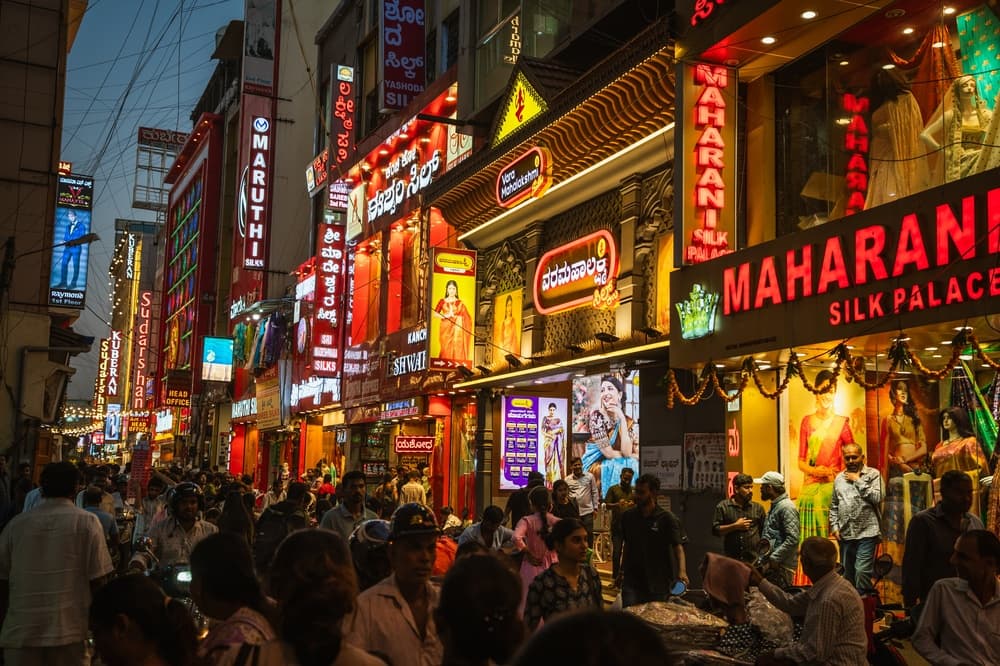
Living in Bangalore: tech jobs, mild weather and famous traffic
What a month costs in India's tech hub, how safe it feels, where expats live, and the visa reality for Americans thinking of moving or retiring there.
- 12,327,000
- Population (2020)
- $1,500/mo
- Monthly budget · single
- 76°F / 25°C
- Avg temperature
Plan on about $1,200 to $1,800 a month for one person in Bangalore, with $1,500 a good middle figure in our 2026 data. A couple lands around $2,200 a month and a family of four around $3,200. A one-bedroom apartment in the center rents for about $450 a month, or about $300 farther out.
Bangalore suits Americans coming for a job at an Indian or global tech company, people with family in the city, and anyone who wants big-city India without the brutal heat of the north. It sits about 3,000 feet up, so average highs stay in the low 80s F for much of the year and peak near 93F in April.
It's a harder fit if you can't stand traffic, need smooth sidewalks, or want to retire here with no Indian tie, since India has no retirement visa. Indiranagar and Koramangala are where many expats start looking.

Reviewed and updated October 14, 2026 · 4 min read
At a glance
$1,500
Monthly budget · single person
$450/mo 1-bed rent, center
55/100
Safety index
$10
Internet / month
76°Fannual average
Dec 71° · Apr 83°
Climate
12,327,000
Population (2020)
Expatsi estimates, updated Oct 2026, based on rental listings, government statistics, and local reporting.
Cost of living
What it costs to live in Bangalore
Single person
$1,200–$1,800/mo
about 50% below Austin, TX
Couple
$1,800–$2,600/mo
about 50% below Austin, TX
Family of four
$2,600–$3,800/mo
about 60% below Austin, TX
Compared with Austin, TX (Expatsi estimate, 2026).
- $2 −90%
- Inexpensive meal
- $350–$550/mo −77%
- 1-bed rent, center
- $250–$350/mo −78%
- 1-bed rent, outside
- $10/mo −85%
- Internet
- $15/mo −64%
- Transit pass
- $223/sq ft −66%
- Buy price, center
Expatsi estimates, updated Oct 2026, based on rental listings, government statistics, and local reporting.
Daily life
How Bangalore lives
- B+ grade, 68th percentile among the cities we track
- Dining & cafésstrong
- A- grade, 79th percentile among the cities we track
- Arts & culturestrong
- B grade, 54th percentile among the cities we track
- Parks & outdoorstypical
- A- grade, 74th percentile among the cities we track
- Schools & educationstrong
- A- grade, 78th percentile among the cities we track
- Healthcare accessstrong
- B grade, 46th percentile among the cities we track
- Bike infrastructuretypical
- B+ grade, 55th percentile among the cities we track
- Public transitstrong
- A- grade, good physical accessibility
- Accessibilitygood
Graded on OpenStreetMap amenity density relative to the 369 cities we track. Accessibility is the exception: it's graded against a fixed standard (terrain steepness and sidewalk surfaces), not a curve.
Climate
Weather through the year
Annual average 76°F (25°C) · 42 in of rain a year · Source: Meteostat station normals (43295, 1991-2020)
On the ground
Scenes from Bangalore
Getting around
Transport in Bangalore
Everyone warns you about Bangalore's traffic, and they're right. Pick where you live by where you'll work: a few miles on the map can mean a long ride at rush hour, and that one choice shapes daily life more than any neighborhood vibe.
Namma Metro is the best way around if your home and office sit near a station. The Purple Line links Whitefield's tech parks with MG Road and Majestic, and the Yellow Line reaches Electronic City along Hosur Road. Fares went up in February 2025, but our data still puts monthly transportation at about $15. The metro line to the airport is still under construction, so for now the airport means a taxi or bus.
City buses fill the gaps, and ride apps work well; Uber even runs booking counters at some metro stations. You can live here without a car, and plenty of people do.
Walking is the weak spot. Local reporting in January 2026 described broken slabs and footpaths blocked by waste or drains, so short trips on foot take more care than you'd expect.
- 27/sq mi
- Transit stops
- 4.0/sq mi
- Bike infrastructure
- 25/sq mi
- Wheelchair-accessible places
Mapped features per square mile from OpenStreetMap.
Keep exploring
Places like Bangalore

Community & practical notes
What daily life looks like for Americans
Who you'll meet
Most Americans here come through a job, a spouse or family. Social life tends to grow out of work, alumni groups and your building rather than a retiree enclave. Pubs, parks and a big restaurant scene make it easy to say yes to plans. India runs one time zone all year, nine and a half to ten and a half hours ahead of Eastern by season, so U.S. calls land in your evening.
The U.S. opened a consulate in Bangalore in January 2025, which shortens the trip for some passport and citizen errands. Visa services weren't offered in its pilot year.
Healthcare
The U.S. State Department says care in India's major cities may meet Western standards, and that most hospitals want payment or proof of insurance before treating you. Bangalore has internationally accredited private hospitals, including Fortis on Bannerghatta Road, which holds JCI accreditation. Sort out insurance before you arrive; our healthcare coach Hunter Schultz and our insurance partner ExpatInsure can help you plan it.
The air
Bangalore's air is far easier than the north's. From 2015 to October 2024, the city logged an air-quality index above 100 on 18% of recorded days, against 83% for Delhi. It still isn't clean on bad days, so check readings if you have asthma or heart trouble.
Internet and work
Home internet averages about $10 a month in our data. If you're keeping a U.S. job, read the remote-work section of our India guide first: India has no nomad visa.
LGBTQ expats
India's Supreme Court decriminalized same-sex relations in September 2018, and Bangalore has held a pride march since 2008, usually in November. India doesn't recognize same-sex marriage, though, so spouse-based visas may not work for same-sex couples. Trans residents have faced police arrests in the city in past years. Expect discretion to matter more than at home.
Black Americans
We couldn't find solid, Bangalore-specific reporting on Black Americans' experience, and we'd rather say that than guess. Before you commit, talk with Black Americans living in India, through professional networks or expat groups, about everyday life in the city.
Limited mobility
This is a tough city to get around with a wheelchair or walker. Local reporting describes uneven slabs and blocked footpaths, and the pedestrian skywalks are largely inaccessible to older and disabled people. Budget for cars and ride apps, and choose a building close to work and daily shopping.
Retiring here
The mild climate and our $1,500 single budget appeal to retirees, but India has no retirement visa. Americans without Indian heritage, an Indian spouse or a job are left with the e-Tourist visa and its 180-day yearly cap, so Bangalore works as a long winter base more than a full-time home. Compare your options on our retirement visa guide, and see who can stay year-round in our guide to moving to India.
Housing
Renting and buying
- 1-bed rent (center)
- $350–$550/mo
- 1-bed rent (outside center)
- $250–$350/mo
- Buy price (center)
- $223/sq ft
- Buy price (outside center)
- $139/sq ft
Expatsi estimates, based on rental listings, government statistics, and local reporting.
Good to know
Frequently asked questions
Can Americans retire in Bangalore?
Not on a retirement visa, because India doesn't have one. Americans with Indian heritage or an Indian spouse may qualify for an OCI card, which allows unlimited stays. Everyone else is generally limited to the e-Tourist visa, which caps time in India at 180 days a calendar year.
What is the weather like in Bangalore?
Mild for India, because the city sits about 3,000 feet up. Average highs run in the low 80s F most of the year and peak near 93F in April. December and January bring average lows near 61F. The wettest months are September and October, and the city gets about 42 inches of rain a year.
Is Bangalore's air quality better than Delhi's?
Yes, by a wide margin. From 2015 to October 2024, Bangalore recorded an air-quality index above 100 on 18% of days, compared with 83% for Delhi. Poor-air days still happen, so check daily readings if you have asthma or heart trouble.
Is Bangalore safe for Americans?
Bangalore scores 55 out of 100 on safety in our data, with a crime index of 45, so it calls for the ordinary precautions of any big city. Traffic and uneven footpaths are the hazards you'll notice every day. Check the U.S. State Department's current India advisory before you go.
Do you need a car in Bangalore?
No. The Namma Metro, city buses and ride apps cover most trips, and our data puts monthly transportation at about $15. Traffic is heavy, so living near work or a metro station matters more than owning a car.
Where do expats live in Bangalore?
Indiranagar and Koramangala are the best-known expat neighborhoods, with restaurants, pubs and shops close by. People working in the big tech parks often live near Whitefield or Electronic City, both reached by the metro, to keep their commutes short.
How much does it cost to live in Bangalore?
In our 2026 data, one person spends about $1,200 to $1,800 a month in Bangalore, with $1,500 a typical figure. A couple spends around $2,200 a month and a family of four around $3,200. A one-bedroom apartment rents for about $450 a month in the center or $300 farther out.
See how Bangalore fits your life
Take the free Expatsi Test and compare India to over 100 countries on what actually matters: cost, healthcare, climate, and safety. About five minutes.
Why not you?