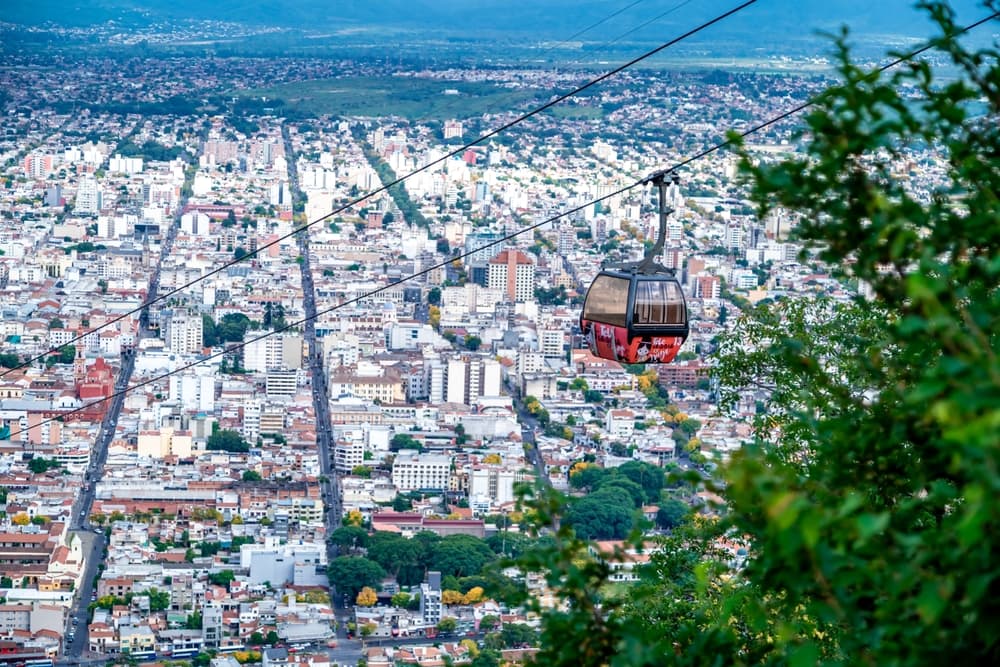
Salta: Argentina's colonial northwest, at about 3,800 feet
A provincial capital of about 595,000 people with sunny, dry winters, a rainy summer, and daily life that happens almost entirely in Spanish.
- 594,772
- Population (2022)
- $1,100/mo
- Monthly budget · single
- 64°F / 18°C
- Avg temperature
Budget about $1,100 a month in U.S. dollars for one person in Salta as of 2026, and most singles land between $800 and $1,400. A couple should plan on around $1,600, and a family of four about $2,400. A one-bedroom near the center rents for roughly $400 a month, or about $300 farther out.
Salta sits in the Lerma Valley, with colonial churches in the center, folk music in the peñas, and the Andes close enough for weekend drives. It works for people on a modest budget who like dry, sunny winters and are ready to run their lives in Spanish.
It's a weaker fit if you need English day to day, an airport with long-haul flights, or an American-style school. Summer is the wet season, with average highs in the low 80s F in December and January.

Reviewed and updated October 9, 2026 · 4 min read
At a glance
$1,100
Monthly budget · single person
$400/mo 1-bed rent, center
52/100
Safety index
$20
Internet / month
64°Fannual average
Jul 53° · Dec 72°
Climate
594,772
Population (2022)
Expatsi estimates, updated Oct 2026, based on rental listings, government statistics, and local reporting. Coverage here is thin, so treat these as a rough guide.
Cost of living
What it costs to live in Salta
Single person
$800–$1,400/mo
about 65% below Austin, TX
Couple
$1,200–$2,100/mo
about 65% below Austin, TX
Family of four
$1,900–$3,000/mo
about 70% below Austin, TX
Compared with Austin, TX (Expatsi estimate, 2026).
- $7 −65%
- Inexpensive meal
- $300–$500/mo −79%
- 1-bed rent, center
- $250–$400/mo −78%
- 1-bed rent, outside
- $20/mo −69%
- Internet
- $121/sq ft −81%
- Buy price, center
Expatsi estimates, updated Oct 2026, based on rental listings, government statistics, and local reporting. Coverage here is thin, so treat these as a rough guide.
Daily life
How Salta lives
- B- grade, 36th percentile among the cities we track
- Dining & caféstypical
- B grade, 49th percentile among the cities we track
- Arts & culturetypical
- B grade, 52nd percentile among the cities we track
- Parks & outdoorstypical
- B+ grade, 60th percentile among the cities we track
- Schools & educationstrong
- B+ grade, 59th percentile among the cities we track
- Healthcare accessstrong
- B- grade, 35th percentile among the cities we track
- Bike infrastructuretypical
- B- grade, 29th percentile among the cities we track
- Public transittypical
- A- grade, good physical accessibility
- Accessibilitygood
Graded on OpenStreetMap amenity density relative to the 298 cities we track. Accessibility is the exception: it's graded against a fixed standard (terrain steepness and sidewalk surfaces), not a curve.
Climate
Weather through the year
Annual average 64°F (18°C) · 28 in of rain a year · Source: Meteostat station normals (87047, 1991-2020)
On the ground
Scenes from Salta
Getting around
Transport in Salta
Without a car, you'll ride Salta's city buses, known by the name of the system, SAETA. Pay with a physical SAETA card: since April 2026, a second bus taken within an hour of the first costs half fare, but only when you tap the card, not when you pay by QR.
If you rent in or near the colonial center, most errands are a walk, and you can skip owning a car. One makes more sense if you live on the edge of town or want to get out into the valleys often.
Two other rides are worth knowing. The teleférico carries gondolas up and down Cerro San Bernardo, the hill above the city. A regional train links Güemes, Salta and Campo Quijano, and you need a reservation before you board.
Ride apps are unsettled. A Salta court ordered Uber to suspend its app in the city in 2020, and in March 2026 Salta Capital and nearby towns signed an agreement to recognize app drivers' permits across town lines. Check what's running when you land.
The airport is about 4 miles southwest of the center, and the flight to Buenos Aires takes just over two hours. Plan on connecting for trips to the U.S.
- 7.5/sq mi
- Transit stops
- 1.5/sq mi
- Bike infrastructure
- 1.1/sq mi
- Wheelchair-accessible places
Mapped features per square mile from OpenStreetMap.
Keep exploring
Places like Salta
Living there
Community and practical notes
Who's here: Salta's foreign community is small, and our records note that English is limited outside tourist areas. You'll need Spanish with landlords, at the bank and at the doctor's office, so start lessons before the move.
Healthcare: Private hospitals such as Sanatorio Parque Salta and Sanatorio El Carmen handle care for people with private coverage. Here's the catch: since February 2024, Salta has charged non-resident foreigners for treatment in its public hospitals, under a decree later made provincial law. Until you hold residency, carry private insurance that pays at the hospital you'd actually use.
Remote work: Home internet costs about $20 a month. We couldn't confirm any established coworking spaces, so test the connection in any apartment before you sign.
Safety: The U.S. State Department rated Argentina Level 1, its lowest advisory, in July 2026. It also warns that robberies by thieves on motorcycles (motochorros) happen often in Argentine cities. Keep your phone away from the curb, and don't resist if someone grabs it.
Schools: Salta has no fully international schools on an American or British curriculum, though some private schools run strong English programs. Families who need a U.S.-style school should look at Buenos Aires.
The local calendar: Faith runs through public life here. The Fiesta del Milagro peaks on September 15, and most businesses close September 13 to 15, which are provincial holidays.
LGBTQ expats: The State Department says Argentina has no legal restrictions on same-sex relationships. Salta has a long-running Pride march: a 2017 call-out by La Izquierda Diario announced the province's 16th.
Black Americans: Travel Noire puts the share of Argentines who identify as African at under 1%, so expect to stand out. We didn't find first-hand accounts from Black Americans living in Salta. Talk with Black expats elsewhere in Argentina before you decide.
Limited mobility: We couldn't find reliable reporting on curb ramps or wheelchair-accessible buses in Salta, so don't assume either. Scout in person, look for a ground-floor rental on a level street close to your errands, and budget for taxis.
Retirement: Salta fits retirees who want sunny winters, can handle the altitude, and are ready to live in Spanish. Argentina has a dedicated retirement visa. Compare it with other countries on our retirement visa hub, and read the Argentina move guide for taxes and banking.
Housing
Renting and buying
- 1-bed rent (center)
- $300–$500/mo
- 1-bed rent (outside center)
- $250–$400/mo
- Buy price (center)
- $121/sq ft
- Buy price (outside center)
- $84/sq ft
Expatsi estimates, based on rental listings, government statistics, and local reporting. Coverage here is thin, so treat these as a rough guide.
Good to know
Frequently asked questions
What is the weather like in Salta?
Summers are warm and wet, with average highs in the low 80s F in December and January and most of the year's rain. Winters are dry and sunny: July averages highs near 68F and lows near 37F.
Do people speak English in Salta?
Not much. Expat.com reports English is limited outside tourist areas, and the city has no fully international schools on an American or British curriculum. Expect to use Spanish for renting, banking and medical visits.
How do you get to Salta from the U.S.?
Fly into Buenos Aires and connect to Salta, a flight of just over two hours. Salta's airport sits about 4 miles southwest of the city center.
How much does it cost to live in Salta, Argentina?
Plan on about $1,100 a month in U.S. dollars for one person as of 2026, with most singles spending between $800 and $1,400. A couple needs around $1,600 and a family of four about $2,400. A one-bedroom apartment in the center rents for roughly $400 a month.
Can Americans retire in Salta?
Yes. Argentina has a retirement visa, and Salta draws retirees who want dry, sunny winters and a smaller city. You'll need Spanish for daily life and private health insurance, since Salta charges non-resident foreigners at its public hospitals.
Is Salta safe for Americans?
The U.S. State Department rated Argentina Level 1, its lowest advisory level, in July 2026. It warns that motorcycle robberies happen often in Argentine cities, so keep phones and bags away from the street side of the sidewalk and don't resist a robbery. Salta scores 52 out of 100 on Expatsi's safety index.
Do foreigners pay for public hospitals in Salta?
Non-resident foreigners do. Salta started charging them for public hospital care in February 2024 under Decree 129/2024, later ratified by provincial Law 8,421. Carry private health insurance, at least until you have Argentine residency.
See how Salta fits your life
Take the free Expatsi Test and compare Argentina to over 100 countries on what actually matters: cost, healthcare, climate, and safety. About five minutes.
Why not you?