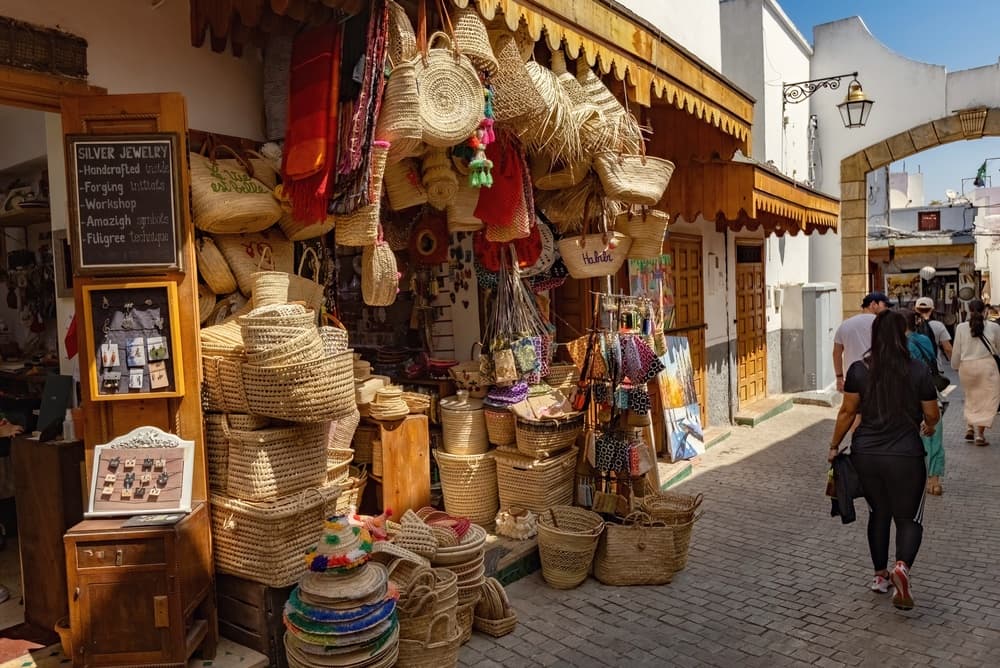
Rabat for Americans: an Atlantic capital at about $1,400 a month
A tram across the river to Salé, fast trains north to Tangier, and the U.S. Embassy in town. Costs, safety, healthcare, and what retiring here takes.
- 515,619
- Population (2024)
- $1,400/mo
- Monthly budget · single
- 64°F / 18°C
- Avg temperature
Our 2026 data puts one person in Rabat at about $1,400 a month in U.S. dollars, with most single budgets between $1,200 and $1,700. A couple lands near $2,200 and a family of four near $3,100. A one-bedroom in a central area rents for about $650, usually $550 to $750, and about $450 farther out.
Rabat is Morocco's capital, a city of about 516,000 people as of 2024, home to the ministries, the embassies, and a slower pace than Casablanca or Marrakech. It suits people who want a calm, orderly base by the ocean, families who want an English-language school, and retirees who'd rather walk the Kasbah of the Udayas than dodge crowds. Most expats settle in Agdal and Hay Riad.
If you want late nights and a big international social scene, Rabat will feel quiet. You'll also get further with French than English. The climate is gentle, with a yearly average near 64 F (17.7 C).

Reviewed and updated October 22, 2026 · 4 min read
At a glance
$1,400
Monthly budget · single person
$650/mo 1-bed rent, center
65/100
Safety index
$30
Internet / month
64°Fannual average
Jan 54° · Aug 73°
Climate
515,619
Population (2024)
Expatsi estimates, updated Oct 2026, based on rental listings, government statistics, and local reporting.
Cost of living
What it costs to live in Rabat
Single person
$1,200–$1,700/mo
about 55% below Austin, TX
Couple
$1,800–$2,500/mo
about 50% below Austin, TX
Family of four
$2,500–$3,700/mo
about 60% below Austin, TX
Compared with Austin, TX (Expatsi estimate, 2026).
- $5 −75%
- Inexpensive meal
- $550–$750/mo −67%
- 1-bed rent, center
- $350–$550/mo −67%
- 1-bed rent, outside
- $30/mo −54%
- Internet
- $30/mo −27%
- Transit pass
- $167/sq ft −74%
- Buy price, center
Expatsi estimates, updated Oct 2026, based on rental listings, government statistics, and local reporting.
Daily life
How Rabat lives
- B+ grade, 61st percentile among the cities we track
- Dining & cafésstrong
- B+ grade, 56th percentile among the cities we track
- Arts & culturestrong
- B grade, 45th percentile among the cities we track
- Parks & outdoorstypical
- B grade, 52nd percentile among the cities we track
- Schools & educationtypical
- B+ grade, 65th percentile among the cities we track
- Healthcare accessstrong
- B- grade, 34th percentile among the cities we track
- Bike infrastructuretypical
- B grade, 42nd percentile among the cities we track
- Public transittypical
- A- grade, good physical accessibility
- Accessibilitygood
Graded on OpenStreetMap amenity density relative to the 436 cities we track. Accessibility is the exception: it's graded against a fixed standard (terrain steepness and sidewalk surfaces), not a curve.
Climate
Weather through the year
Annual average 64°F (18°C) · 20 in of rain a year · Source: Meteostat station normals (60135, 1991-2020)
On the ground
Scenes from Rabat
Getting around
Transport in Rabat
The tram is the backbone of daily life here. The Rabat-Salé network crosses the Bouregreg River and links the centers of both cities, with 43 stations on about 17 miles of track, according to its operator. One stop sits right outside Rabat-Ville train station. It doesn't reach the airport or Rabat-Agdal station, so plan a taxi for those.
Trains handle trips out of town. Casablanca is about an hour south, and Al Boraq high-speed trains leave Rabat-Agdal for Tangier, arriving in about 1 hour 20 minutes.
For short hops, people use taxis or apps. The State Department says taxis are generally crime-free during the day. Uber returned to Morocco in November 2025 and runs in Rabat again, working through licensed transport partners. Keep your wits about you at pickup points, though: the State Department notes that rideshare drivers and passengers have reported harassment and violence from taxi drivers.
Most newcomers skip the car. The State Department calls driving practices very poor, and if you live near a tram stop in Agdal, Hay Riad, or the center, the tram, taxis, and trains cover nearly everything.
- 15/sq mi
- Transit stops
- 0.7/sq mi
- Bike infrastructure
- 1.5/sq mi
- Wheelchair-accessible places
Mapped features per square mile from OpenStreetMap.
Keep exploring
Places like Rabat
Community
Community & practical notes
Community: Rabat's foreign crowd leans toward diplomats, NGO staff, teachers, and their families, so social life tends to run through schools, embassies, and dinner invitations rather than bars. The U.S. Embassy is on Avenue Mohamed VI in the Souissi district. French is the everyday second language, and a few words of Moroccan Arabic go a long way at the market.
Healthcare: The State Department says most hospitals and doctors want cash, medical staff may speak little or no English, and Medicare doesn't cover you abroad. Hunter Schultz, our healthcare coach, can help you figure out where you'd go for care in Rabat, and ExpatInsure sets up international health coverage that travels with you.
Safety: The State Department rates Morocco Level 2, Exercise Increased Caution, as of September 2026, because of terrorism risk. Day to day, petty crime is the bigger concern in major cities, so keep your phone and bag close in crowds and on the tram.
LGBTQ expats: Same-sex relations are a crime in Morocco, punishable by fines and up to three years in prison. That law applies in Rabat as everywhere else, and it should weigh heavily in your decision.
Black Americans: The State Department says travelers who appear to be of sub-Saharan African descent have reported discrimination or harassment in Morocco. Experiences vary, so talk with Black Americans living in Rabat now before you commit.
Limited mobility: The State Department warns that accessibility is limited in public transportation, lodging, and general infrastructure, and that disability laws aren't consistently enforced. The tram operator says its network was designed to be accessible, which helps, but check building entrances, elevators, and the walk to your stop in person before you sign a lease.
Remote work and schools: Spaces has four coworking locations in Rabat, including in Agdal and Hay Riad. For families, Rabat American School teaches Pre-K through grade 12 in English, is accredited by the Middle States Association, and has offered the International Baccalaureate Diploma since 1992.
Retirement: Morocco has no dedicated retirement visa. Retirees usually live on a visitor registration card for people with enough income who won't work in Morocco. You apply within 90 days of arriving, and you'll need a criminal record check from home, so order yours before you leave the U.S. Compare retirement visa options or read our full Morocco guide.
Housing
Renting and buying
- 1-bed rent (center)
- $550–$750/mo
- 1-bed rent (outside center)
- $350–$550/mo
- Buy price (center)
- $167/sq ft
- Buy price (outside center)
- $102/sq ft
Expatsi estimates, based on rental listings, government statistics, and local reporting.
Good to know
Frequently asked questions
Can I retire in Rabat?
Yes, though not on a retirement visa, because Morocco doesn't have one. Retirees usually hold a visitor registration card, meant for people with enough income who won't work in Morocco. You apply within 90 days of arriving, with a criminal record check from your home country.
What is the weather like in Rabat?
Mild all year. January averages highs near 64 F and lows near 45 F, and August highs average near 82 F. Most rain falls from November through January, summers are nearly dry, and the city gets about 20 inches of rain a year.
How far is Rabat from Casablanca and Tangier?
Casablanca is about an hour south by train. Al Boraq high-speed trains run from Rabat-Agdal station to Tangier in about 1 hour 20 minutes.
Do I need a car in Rabat?
Most newcomers don't. The Rabat-Salé tram, taxis, Uber, and trains cover daily life, and the State Department describes Moroccan driving practices as very poor. A car mainly helps for regular trips into the countryside.
Do people speak English in Rabat?
Some do, especially younger people and those working with foreigners, but French is far more useful day to day for paperwork, doctors, and landlords. Learning basic French and a few phrases of Moroccan Arabic makes life much easier.
How much does it cost to live in Rabat?
Our 2026 data puts one person at about $1,400 a month in U.S. dollars, with most single budgets between $1,200 and $1,700. A couple typically spends $1,800 to $2,500, and a family of four $2,500 to $3,700. A central one-bedroom usually rents for $550 to $750 a month.
Is healthcare good in Rabat?
As the capital, Rabat has both public hospitals and private clinics, but expect to pay cash up front and to meet staff who speak little English, according to the State Department. Plan on international health insurance, since Medicare doesn't apply outside the U.S.
Is Rabat safe for Americans?
Rabat is a calm city, but Morocco carries a State Department Level 2 rating, Exercise Increased Caution, as of September 2026 because of terrorism risk. Petty crime is the everyday concern in Moroccan cities. Same-sex relations are a crime in Morocco, which matters a great deal for LGBTQ Americans.
See how Rabat fits your life
Take the free Expatsi Test and compare Morocco with other countries on what actually matters: cost, healthcare, climate, and safety.
Why not you?