A job offer in Germany, permanent residence 21 months later
The EU Blue Card goes to degree holders whose German salary clears about $58,600. Americans get to skip the consulate and file for it after they land.
Germany gives the Blue Card to people with a degree and a German contract that pays enough. Clear the salary line and you get a permit that lets your spouse work right away, converting to permanent residence faster than any other German permit.
The three tests
What Germany checks before it says yes

The Blue Card sits in Section 18g of the Residence Act and asks three questions. None is about your German.
The number on your contract
For 2026 the standard floor is 50,700 euros gross a year, about $58,600, or 4,225 euros a month. If your job is on the federal shortage list (STEM, IT, medicine, nursing, teaching, some manager roles), or you finished your last degree under three years ago, the floor drops to 45,934.20 euros, roughly $53,100, with Federal Employment Agency sign-off. Bonuses do not count. Base salary clears the line on its own.
What counts as a degree
A German degree, a foreign degree Germany treats as comparable, or any tertiary qualification of three years or more. U.S. degrees from regionally accredited schools are usually rated H plus in the anabin database, and a printout is often all a caseworker wants. If your school is not listed, the ZAB writes a statement of comparability for 208 euros (about $240) in two to three months.
The offer itself
Six months minimum, and matching what you studied. Regulated work (doctors, nurses, teachers) needs the professional license in hand or clearly on its way. No offer yet? That's what the Opportunity Card is for.
The Blue Card in four numbers
$58,600
Standard salary floor for 2026
50,700 euros gross a year, or 4,225 a month
$53,100
Shortage jobs and recent grads
45,934.20 euros, with employment agency sign-off
21 months
To permanent residence with B1 German
27 months if your German stops at A1
$115
What the card itself costs
100 euros at the foreigners office, set nationwide
The money
Read the salary the way a German payslip does

Fifty thousand euros can look thin next to a US tech offer, so measure it against local pay. Destatis puts the median full-time German salary near 54,066 euros a year including bonuses, so the standard floor sits just under what a typical German worker earns. This is not a rich-person permit.
Then take the deductions seriously. Pension, health, long-term care and unemployment insurance run about 21 percent of gross between them, and income tax climbs from 14 percent past the 12,348 euro allowance to 42 percent above 69,879. Get In Expat, the Germany relocation partner we work with, puts the rule of thumb at roughly 60 percent of gross reaching your account as a single filer in tax class one.
At the floor, that's roughly 2,500 euros a month net, close to $2,900, against the $2,200 our Germany data gives as a single person's monthly costs. Comfortable in Leipzig, tight in Munich. You also keep filing a U.S. return, though the foreign earned income exclusion ($132,900 for 2026) and the credit for German tax paid usually leave nothing owed. Our Germany guide has the rest of the budget.
EU Blue Card
For highly qualified non-EU professionals with a job offer in Germany. Fast-track to permanent residence (21 months with German language, 33 months without). Full family reunification.
- Government cost
- $100
- Processing time
- ~60 days
- Timeline
- Up to 4 years, renewable
- Difficulty
- Moderate
Key requirements
- University degree recognized in Germany
- Job offer in Germany with minimum salary (€43,800 for 2025, lower for shortage occupations)
- Health insurance
- Proof of financial means
About that data card
Our data card is a year behind in three places, and the fixes are already requested. The salary in the requirements list is the 2025 figure: for 2026 it is 50,700 euros, or 45,934.20 for shortage jobs and recent graduates. The fast track to permanent residence is 27 months with A1 German, not 33 with none, because A1 is required either way. And that 100 is euros, so about $115 USD.
The American shortcut
You can fly over first and file once you're there
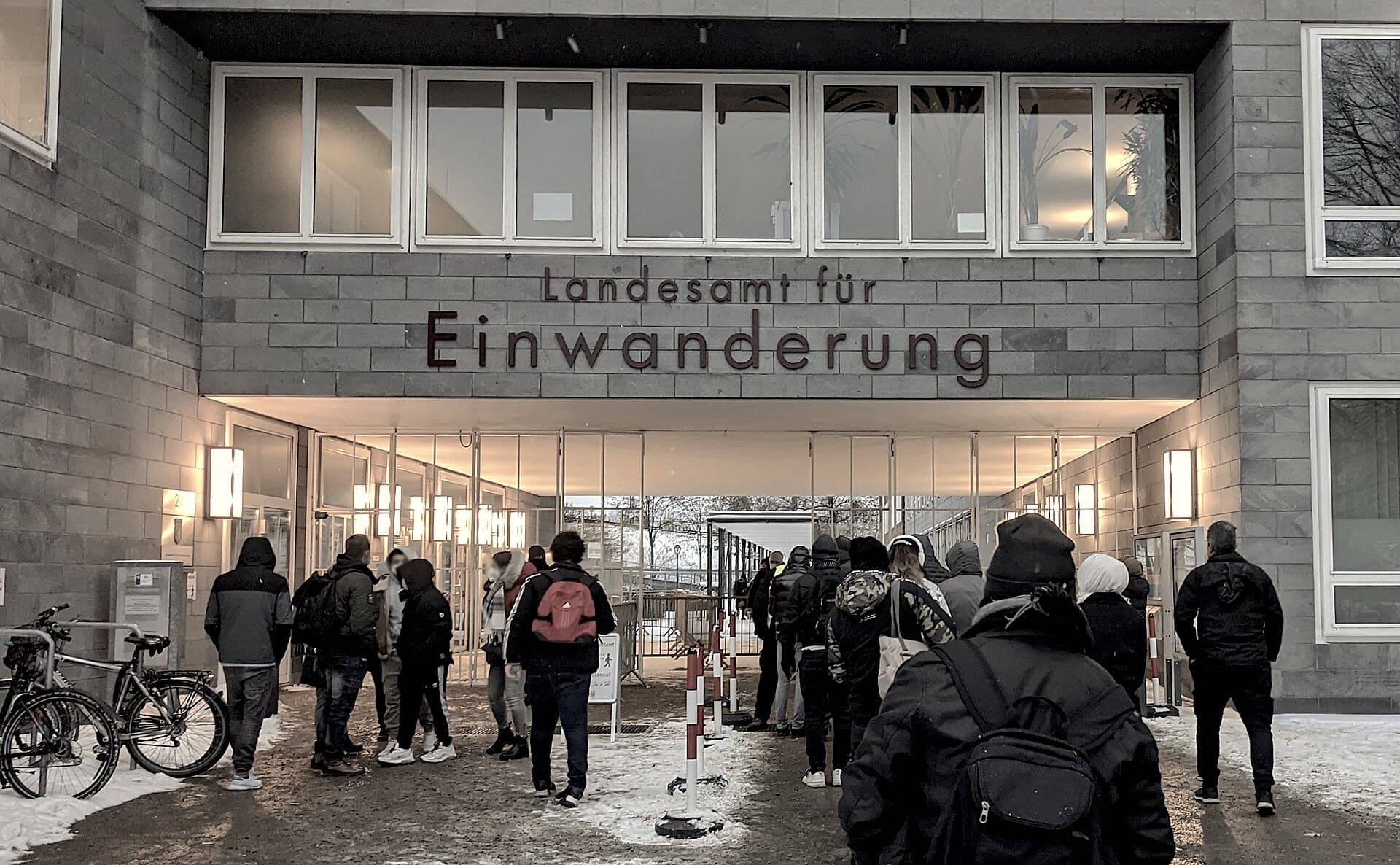
Section 41 of the Residence Ordinance names eight nationalities that can enter Germany without a visa, then apply for a residence permit from inside the country. Americans are on that list, along with Canada, the UK, Australia, Japan, South Korea, New Zealand and Israel. Your application has to reach the local foreigners office within 90 days of landing; once filed, it keeps you legal past day 90.
The trade: you can't work until the card is issued, and appointments at busy offices book out weeks ahead. Plenty of people with a signed contract still get a national visa at a German consulate in the U.S. (75 euros, about $87), start on day one, and convert after they arrive.
Going over first, the order runs lease, address registration within about two weeks, then the appointment with your contract, degree paperwork, health insurance and passport. In Berlin, the card turns up four to six weeks later.
What the card carries beyond the right to work
Your spouse works from day one
Your husband or wife joins with no German test, and can take any job from the day their permit is issued.
The shortest road to permanent
Settlement permit at 21 months with B1 German, 27 with A1, as long as pension contributions run the same stretch.
Twelve months in, the EU opens up
After 12 months in Germany, you can take the card to a second EU country for work on a lighter process.
More time abroad without losing it
German permits normally lapse after six months abroad. Blue Card families get twelve.
Cover if the job ends
Valid three months after the job ends, six once you've held it for two years.
No German at the counter
Nothing in the application tests your German. Language only sets how fast the residence clock runs.
The honest part
Here's the catch

The bar moves every January
The floor is a formula, half the pension insurance contribution ceiling, so it climbs with German wages: 45,300 euros in 2024, 48,300 in 2025, 50,700 in 2026. A salary that cleared the line when you signed can sit under it at renewal, so negotiate a margin.
Year one, the job is part of the permit
Change employers inside the first twelve months and the foreigners office checks whether the new job still qualifies. After twelve months that check drops away. Either way, report changes within two weeks, including a job that ends.
German is the price of permanence
You can get the card without a word of it. The settlement permit needs at least A1, and B1 is what buys the 21-month clock. Citizenship runs longer: five years, dual nationality allowed since 2024, and the old three-year fast track ended on October 30, 2025.
Germany's other residence routes
Freelancer/Self-Employment Visa
- Business plan
- Proof of demand for services
- Proof of financial means
National Work Visa (D-Visa)
- Job offer from German employer
- Qualification recognition for regulated professions
- Health insurance
Opportunity Card (Chancenkarte)
- Points-based eligibility (degree, language, experience, age, Germany connection)
- Proof of financial means (typically €12,000 in blocked account)
- Health insurance
Student Visa
- University admission letter
- Proof of financial means (€11,208/year in blocked account)
- Health insurance
Help with the parts that stall
Three things stall Blue Card moves: a degree that isn't cleanly listed in anabin, a first U.S. tax return filed from Germany, and a settlement permit with no language certificate attached.

Get In Expat
Germany Relocation Specialist
A Germany relocation specialist whose service list names the EU Blue Card outright. Degree recognition, the foreigners office file, the address registration that comes first.
MyExpatTaxes
U.S. Expat Tax Service
The U.S. return doesn't stop when your paycheck turns into euros. They handle Form 2555, the credit for German tax paid, and the foreign account report new arrivals trip over.

Lingoda
Language Learning
Online German classes at the levels that decide your residence clock. A1 opens the settlement permit at 27 months. B1 pulls it forward to 21.
Questions Americans ask about the Blue Card
What happens to my Blue Card if I lose my job in Germany?
The card does not die with the contract. It stays valid three months after employment ends, or six if you have held it at least two years, which buys time to find another qualifying role. Tell the foreigners office within two weeks of learning the job is ending.
How quickly can a Blue Card holder get permanent residence in Germany?
After 27 months of Blue Card employment with A1 German, or 21 with B1, provided you paid into the statutory pension scheme throughout and pass the civics test. Only time holding the Blue Card counts, so months on a job seeker permit or a national visa beforehand do not shorten the wait.
Can I get an EU Blue Card without a university degree?
Only through the IT route. If you have worked in IT for three of the past seven years at a level comparable to a degree, and your offer pays at least 45,934.20 euros, Germany can issue the card with Federal Employment Agency approval. Everyone else needs a degree or a tertiary qualification of at least three years.
Do I need to speak German for a German Blue Card?
No. The application does not test your German, and neither does your spouse's. Language matters later: A1 is required for the settlement permit at 27 months, and B1 pulls that forward to 21. Certificates have to come from a recognized examiner such as the Goethe-Institut, telc or ÖSD.
Can my spouse work in Germany on a Blue Card?
Yes. A Blue Card holder's spouse does not have to prove any German before arriving, and their residence permit carries unrestricted permission to work from the day it is issued. No separate work authorization, no salary minimum on their job, no waiting period.
Can an American apply for the Blue Card from inside Germany?
Yes. Section 41 of the Residence Ordinance lets US citizens enter without a visa and apply at the local foreigners office, as long as the application goes in within 90 days of arrival. You cannot work until the card is issued, so people who want to start right away often get a national visa at a German consulate first and convert after they land.
What is the minimum salary for an EU Blue Card in Germany in 2026?
50,700 euros gross a year, about $58,600, for standard occupations. It drops to 45,934.20 euros (roughly $53,100) for shortage jobs such as IT, engineering, science, medicine and teaching, for people whose last degree is under three years old, and for IT specialists without a degree. Those cases need Federal Employment Agency approval, and the figures reset every January.

Is Germany the right fit, or does another country suit you better?
Answer a few questions and see which countries fit the life you are after, Germany included.
Why not you?