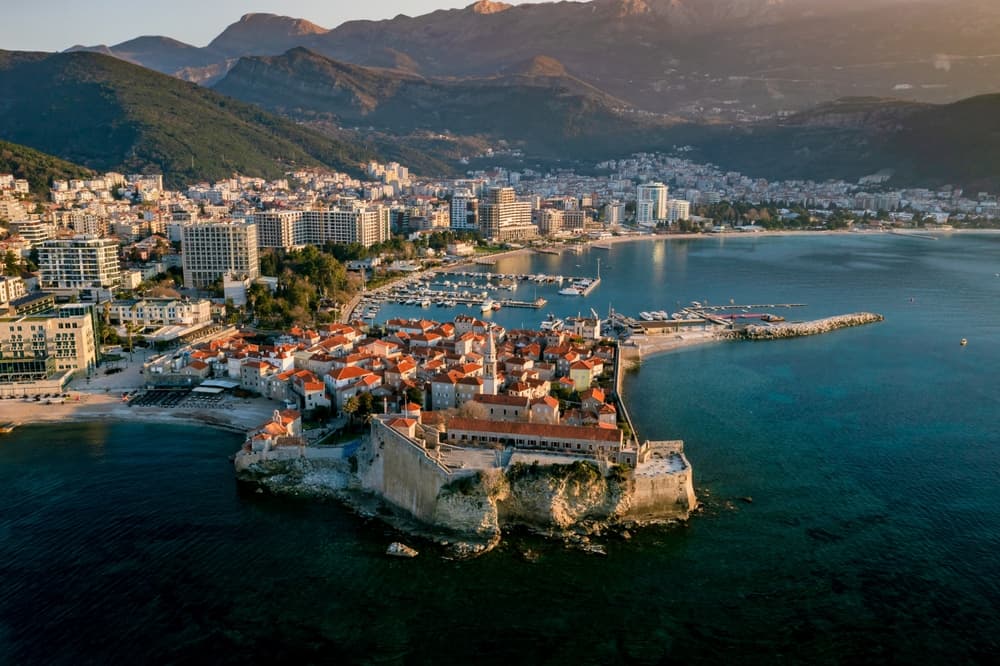
Budva: a walled Old Town, a long beach, and two different seasons
Montenegro's liveliest stretch of coast, with English-language schools, private clinics, and town buses to Sveti Stefan all year, plus summers that are loud and crowded.
- 13,338
- Population (2011)
- $1,800/mo
- Monthly budget · single
- 62°F / 16°C
- Avg temperature
One person can live in Budva on about $1,800 a month in U.S. dollars, and most singles land between $1,400 and $2,200. A couple needs about $2,800. A one-bedroom in the center rents for around $900 a month, or about $650 farther out, and a meal at an inexpensive restaurant is about $11. Those are 2026 figures.
Budva is the Montenegrin coast at its most social: a walled Old Town on a small peninsula, a run of beaches toward Bečići and Sveti Stefan, and a lot of newcomers. In Montenegro's 2023 census, the share of foreign citizens living in Budva municipality was about four times the national rate. That crowd is why you'll find English-language schools and private clinics in town.
Budva suits people who want a sociable beach town with services close by and don't mind sharing it with crowds in July and August. It's a harder fit if you want a quiet summer or a busy winter. Many beach bars and seasonal restaurants close for the cold months, and the town is at its quietest from December through February.

Reviewed and updated October 8, 2026 · 4 min read
At a glance
$1,800
Monthly budget · single person
$900/mo 1-bed rent, center
72/100
Safety index
$35
Internet / month
62°Fannual average
Jan 46° · Aug 79°
Climate
13,338
Population (2011)
Expatsi estimates, updated Oct 2026, based on rental listings, government statistics, and local reporting. Coverage here is thin, so treat these as a rough guide.
Cost of living
What it costs to live in Budva
Single person
$1,400–$2,200/mo
about 40% below Austin, TX
Couple
$2,100–$3,500/mo
about 40% below Austin, TX
Family of four
$3,200–$4,900/mo
about 50% below Austin, TX
Compared with Austin, TX (Expatsi estimate, 2026).
- $11 −45%
- Inexpensive meal
- $700–$1,100/mo −54%
- 1-bed rent, center
- $500–$800/mo −52%
- 1-bed rent, outside
- $35/mo −46%
- Internet
- $307/sq ft −53%
- Buy price, center
Expatsi estimates, updated Oct 2026, based on rental listings, government statistics, and local reporting. Coverage here is thin, so treat these as a rough guide.
Daily life
How Budva lives
- B- grade, 39th percentile among the cities we track
- Dining & caféstypical
- C grade, 15th percentile among the cities we track
- Arts & culturemodest
- B grade, 42nd percentile among the cities we track
- Parks & outdoorstypical
- C+ grade, 17th percentile among the cities we track
- Schools & educationmodest
- B- grade, 31st percentile among the cities we track
- Healthcare accesstypical
- C- grade, 0th percentile among the cities we track
- Bike infrastructuremodest
- C+ grade, 19th percentile among the cities we track
- Public transitmodest
- B- grade, moderate physical accessibility
- Accessibilitymoderate
Graded on OpenStreetMap amenity density relative to the 298 cities we track. Accessibility is the exception: it's graded against a fixed standard (terrain steepness and sidewalk surfaces), not a curve.
Climate
Weather through the year
Annual average 62°F (16°C) · 83 in of rain a year · Source: Open-Meteo Historical Weather API (temps: ERA5-Land 0.1°; precip/sunshine: ERA5 best-match; 1991-2020 normals)
On the ground
Scenes from Budva
Getting around
Transport in Budva
Budva's town buses are run by Mediteran Expres and leave from Mediteranska Street. The lines to Sveti Stefan and Petrovac run all year, and on the tourist board's timetable the Sveti Stefan bus comes every 10 minutes until 10 p.m. For the rest of the country, the intercity bus station has service to Kotor, Tivat, Podgorica and Bar, plus international lines to Serbia, Croatia, Bosnia and Herzegovina, and North Macedonia.
There's no train in Budva. The nearest stations are Sutomore, Bar and Podgorica, each about an hour's drive away. For flights, Tivat Airport is about 12 miles (20 km) away and Podgorica Airport about 37 miles (60 km).
Uber and Bolt don't operate in Montenegro. Taxis wait at stands or come by phone, and the local app MonteGO has licensed drivers in Budva. Agree on the fare before you set off. The Old Town is a maze of narrow stone streets you'll cover on foot anyway.
Here's the catch: the coastal road through town gets heavily congested in peak summer, and the planned Budva bypass is still in preparation. Parking near the Old Town is hard to find and expensive. If you live near the center and the bus lines, you can skip a car. If you live up the hill or want weekends inland, you'll want one.
- 2.8/sq mi
- Transit stops
- 0.0/sq mi
- Bike infrastructure
- 5.3/sq mi
- Wheelchair-accessible places
Mapped features per square mile from OpenStreetMap.
Keep exploring
Places like Budva
Community
Community & practical notes
Community: You won't be the only newcomer. Several Budva schools and kindergartens teach in Russian as well as English, which tells you a lot about who has moved here in recent years. Expats find each other through groups like Digital Nomad Montenegro on Facebook. In shops, restaurants and private clinics English works fine; at a municipal office or bank branch, bring patience or a Montenegrin speaker.
Healthcare: Public primary care runs through the Dom zdravlja Budva health center. The nearest public hospital is the Clinical Hospital Center in Kotor, and the Clinical Center of Montenegro in Podgorica handles more complex cases. Medical Vraneš lists 24-hour clinics in central Budva and in Bečići. Plan on paying for care out of pocket or through insurance, even at public facilities.
Remote work: Home internet runs about $35 a month. Budva has a handful of coworking spaces, including a Spaces serviced-office center. Confirm opening hours before you commit, especially in winter.
Schools: Dukley Academy is a British international school that teaches in English, from early years through age 18. Adriatic College offers the IGCSE and the IB Diploma for ages 5 to 18, teaching in English and Russian.
Limited mobility: Plan carefully. We couldn't find accessibility guidance from the town or tourist board, and the Old Town's narrow stone lanes are tough going with a wheelchair or walker. Summer crowds make every sidewalk harder. Look for an apartment on level ground near a bus stop, ask about building elevators before you sign, and visit in the off-season first.
Retirement: Budva works for retirees who want company, beaches and a clinic nearby, with January highs averaging about 51°F. Montenegro has no retirement visa, though. Retirees usually qualify for temporary residence another way, most often through property they own, and the rules changed in January 2026. Montenegro also won't let you keep U.S. citizenship if you naturalize. Read the details in our Montenegro guide, and compare countries that do offer a pension route on our retirement visa page.
Housing
Renting and buying
- 1-bed rent (center)
- $700–$1,100/mo
- 1-bed rent (outside center)
- $500–$800/mo
- Buy price (center)
- $307/sq ft
- Buy price (outside center)
- $214/sq ft
Expatsi estimates, based on rental listings, government statistics, and local reporting. Coverage here is thin, so treat these as a rough guide.
Good to know
Frequently asked questions
How much does it cost to live in Budva, Montenegro?
Plan on $1,400 to $2,200 a month for one person in Budva, in U.S. dollars, and about $4,000 a month for a family of four. These are 2026 figures. Rent is the biggest variable: a one-bedroom outside the center averages about $650 a month, less than one near the Old Town.
Can I retire in Budva, Montenegro?
Yes, but not on a retirement visa, because Montenegro doesn't have one. Retirees usually get temporary residence another way, most often by owning property that meets the government's minimum value. The Law on Foreigners changed in January 2026, so confirm the current rules with the Ministry of Interior or a local lawyer before you buy.
Can Americans get Montenegrin citizenship?
Only by giving up U.S. citizenship. Montenegro requires people who naturalize to renounce their previous citizenship, so most Americans who live there stay on renewable residence permits instead.
Is Budva safe for Americans?
Generally, yes. Budva scores 72 out of 100 on our safety index. The usual resort-town problems apply: busy summer crowds, pickpocketing risk, and taxi overcharging, so agree on the fare before you ride. Check the U.S. State Department's current advisory for Montenegro before you move.
Is English spoken in Budva?
In shops, restaurants, private clinics and international schools, yes. Government offices, banks and the police are harder, so learning some Montenegrin helps. It's close to Serbian, Bosnian and Croatian, so it carries over to neighboring countries too.
What is the weather like in Budva in winter?
Mild and wet. Average highs in January are near 51°F, and November is the rainiest month of the year. Summers are hot and dry, with August highs averaging about 85°F.
Does Budva shut down in the off-season?
Partly. Many beach bars, boat tours and seasonal restaurants close for winter, and the town is quietest from December through February. Year-round residents still have town buses, the public health center, private clinics, schools and supermarkets.
Do you need a car in Budva?
Not if you live near the center. Town buses run all year to Sveti Stefan and Petrovac, intercity buses reach Kotor, Tivat, Podgorica and Bar, and taxis are easy to find. Uber and Bolt don't operate in Montenegro, and there's no train in Budva. A car helps if you live up the hill or want weekends inland.
See how Budva fits your life
Take the free Expatsi Test and compare Montenegro to over 100 countries on what actually matters: cost, healthcare, climate, and safety. About five minutes.
Why not you?